Introduction
The rollover simulation package provides scripts and user subroutines to Abaqus Standard (i.e. quasi-static analysis) for simulating an elastic wheel rolling over a rail. The rail can have complex geometry and material behavior, but the mesh at the end faces must be periodic.
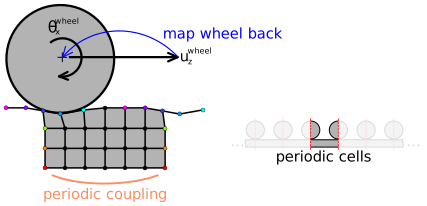
As shown to the right in the figure, the simulation effectively considers an infinite number of periodic cells, where the wheel spacing equals to the simulated rail length. The purpose of this setup is to obtain accurate displacements for much shorter rail lengths compared with not using the periodic boundary conditions.
Between each simulation, the wheel is mapped back to a new starting position. The wheel is modeled as a linear elastic super-element (substructure), removing redundant degrees of freedom. The wheel must be rotationally symmetric.
Implementation
The implementation consists of (1) a python library with functions to setup the Abaqus simulations and (2) fortran user subroutines for mapping back the wheel, as well as for modeling the wheel itself.
The python library can be called either via plugins from within the Abaqus CAE (How to run using cae), or from the command line using various input files (How to run using scripts). Modifications of the rail can be done from within Abaqus CAE, making it possible to use multiple materials, adding geometric features, changing the mesh, and so on.
Scripts are provided for combining the included fortran subroutines with additional subroutines, such as material models (see Compiling user subroutines).